
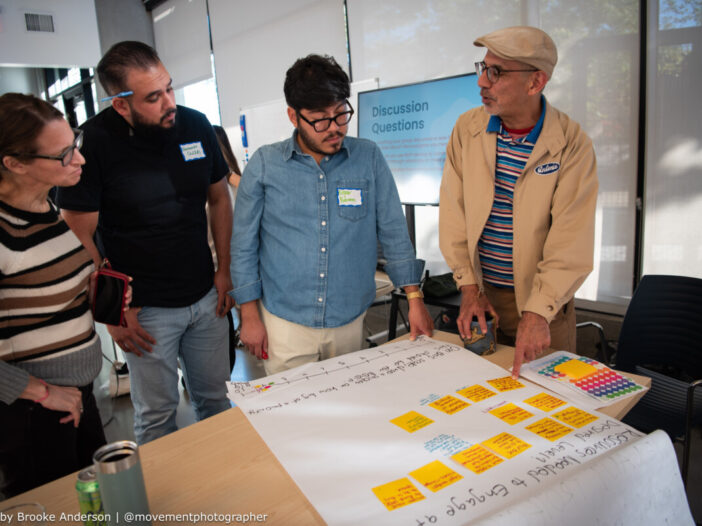
In response to BEEP’s Preliminary Report in 2022, the California Air Resources Board contracted with researchers at UC Berkeley to investigate our concerns and develop policy recommendations. UC Berkeley’s final report has now been posted online!
BEEP members were excited to participate in this project as part of the participatory action research team. The findings and recommendations from this report reflect our experiences on the ground. CARB will be hosting the UC Berkeley research team for a virtual briefing on July 16th – the public is encouraged to attend and provide feedback!
The final report makes the following recommendations:
System Level
- Coordinate across agencies. Form an inter-agency working group to align program design, implementation, and evaluation across state agencies and local representatives, and to report on progress toward climate, energy, and equity goals.
- Build cross-sector partnerships. Align funding across energy, housing, and healthcare partners so the combined health, safety, and electrification work needed in the worst housing conditions can be financed together.
- Fund CBOs as strategic partners. Engage community-based organizations as fully compensated partners across program design, implementation, and evaluation.
Program Design
- Fund retrofit needs in priority communities. Allocate flexible funding for health, safety, and electrical upgrades as a fundamental prerequisite to electrification.
- Enable incentive stacking. Coordinate measures and eligibility criteria across energy, health, and housing programs so households can layer support efficiently.
- Match incentives to need. Rely on no-cost direct-install programs for low-income households and expand inclusive utility investment or green financing for moderate-income households.
- Protect energy affordability. Scope programs to reach bill neutrality or savings and help participants enroll in bill-assistance programs and rate plans suited to their needs.
- Invest in participant support and renter protections. Provide support across learning, capacity, and post-installation education—scaling proven California models such as the energy navigator and local resource centers—and adopt enforceable tenant protections in all programs affecting renters.
- Tailor to ownership structure. Design targeted programs for HOAs, affordable housing, multifamily buildings, and manufactured home parks, addressing split incentives and ensuring solar and storage benefits are distributed equitably across all units rather than a single meter or owner
Program Implementation
- Align energy infrastructure with retrofits. Coordinate electrical panel and grid-capacity upgrades with decarbonization projects so homes have the technical capacity to electrify.
- Invest in workforce development. Standardize decarbonization certifications, fund highroad training partnerships, and support small contractors with capital access and simplified reporting to help them enter the market.
- Equip local governments. Provide building departments with training and standardized guidelines for new technologies to expedite and standardize permitting.
- Use place-based approaches. Apply geographic clustering or zonal decarbonization to coordinate building retrofits, grid upgrades, and gas decommissioning at the neighborhood scale.
Program Evaluation
- Refine benefit-cost analysis. Incorporate health, comfort, and safety non-energy benefits into the Societal Cost Test (SCT) and Total Resource Cost (TRC) Test to reflect the full value of programs serving priority populations.
- Embed distributional equity analysis. Require programs to report participation, drop-off rates, and funds distributed by income, race, tenure, housing type, and geography.
- Standardize equity metrics. Collect granular, participant-level data on race, income, tenure, and housing type across all programs rather than relying on neighborhood proxies.
- Measure energy insecurity. Use standardized pre- and post-retrofit surveys built on the project’s Energy Security Score to verify that programs improve the physical, economic, and coping dimensions of household energy security.

